A black-robed inquisitor, slight of body, disrobed by his mother often, angry.
A big mouth woman, always open, pronouncing her lack of cock and balls as blessing upon the dirty, dark-haired girls who give birth in the street.
A sentient whip that licks chunks of her off its leather, closes its eyes and rapturous splits her open from ass to nape, slashes harder, harder her sweaty inner thighs.
A stake, a torch, a flame, her silence— the rendered fat, the glistening bone.
The misshapen baby with a port wine stain who toddles off at night on his rickety legs to die curled in the blind ivy that overtook her grave.
If you threw the Empire State Building into a raging sea, no one would know the difference. Deepak Chopra said something like that, advocating for meditation. I bet the people of New York would know the difference–their skyline sadly quieter again.
But not silent.
There is no such thing. Like time and god, it’s something we conceptualize, track our lives by, aspire to. But there is always some sound. There is always some imperfection. Our own breath. Our own heartbeat. The mortal body regulating itself as it slowly, calmly perishes.
And that’s not a bad thing. Humans will never be gods and humans will also never know silence or be silent. We are the creatures we are, natively, and we are an unsubtle, noisy lot.
When I try to be silent, movies related to the logistics of eternity flicker across the insides of my eyelids. I’ve learned (sometimes) to watch and not participate, like seekers of silence and stillness are supposed to do, but even when the films are silent films, there is still the sound of the flickering, still the hum of electricity to projector that bolts through the physical brain. The slapstick of memory and trauma and dream and inspiration plays itself out and I laugh. As silent as I am, as unmoving as my belly and throat are–still there is the laugh.
That’s probably the foundational sound of the universe–the breath and heartbeat sound even She can’t get away from when She curves back into herself to resettle before birthing herself, from herself, again.
I’ve lived in three of the four bedrooms of the house I grew up in. I started at the end of the hall, moved across the hall to the front of the house, then back across the hall to the biggest of the little bedrooms, at last. When I lived in the bedroom at the front of the house, my window looked out on the walk, the lawn, the sidewalk, the streetlight that was supposed to be orange but was always broken, the street, the across-the-street neighbor’s house, and the across-the-street neighbor’s house’s front windows–their living room and a little square bedroom just like mine.
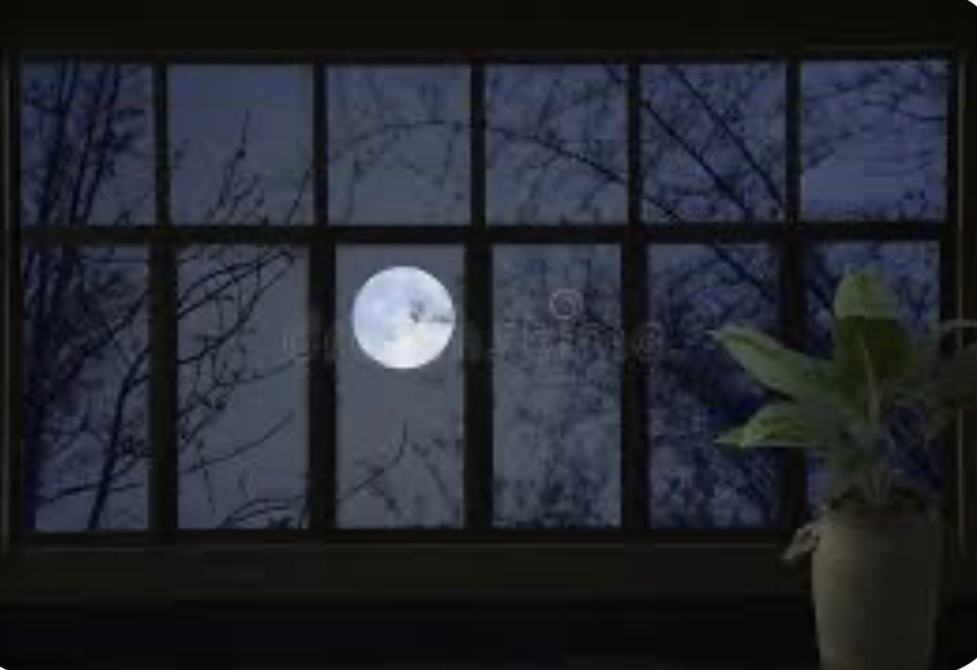
I slept with the head of my bed up against the window. I liked to look out through the blinds at night and contemplate the mysteries of junior high vis a vis the mysteries of the mostly empty street, an unhurried car passing once in a great while.
One night, my boyfriend and two of his friends came to the window. They whispered and laughed and sang and coaxed me out without permission. I think it might have been all of 10:00pm. We were doing what good kids walking the razor sharp line between good kids and slightly less good kids do. We thought we were stealing the world. It’s good we thought that.
Just now the thought: I have had romantic experiences in my lifetime after all, or at least this one–and the several times after that it also happened once they figured out I was so easily persuaded. Once they figured out I was just bad enough.
I came to expect them. I prepared myself for it. I dressed. I made sure my hair was ok, but not too ok. When my best friend came to my house for a sleepover, I made sure her clothes and hair were also ok, but not too ok. She was the best of the good kids. To her, we really were stealing the world. She looked afraid when I told her they would come. She went along anyway.
I can’t drive because I’m legally blind and it is one of the most horrible kinds of crippling, or at least I imagine it is. Having never been an independent driver, I wouldn’t know.
I don’t know what it’s like to have a notion to go somewhere and just go. Cold night, playing Freeze Out like my dad used to do with us girls in the car—all four windows down, whoever rolls theirs up last is the winner—but with only myself as competition. I’ve never had to keep myself awake with only myself and the double yellow lolling out endlessly before me in the dark dark desert between here and Las Vegas.
I don’t know what hitting 100mph is like on that same highway, in the middle of the night, when I’m sure the CHP isn’t watching.
Yellow line, lulling you to sleep. Blaring the radio to fight it, Botts’ dots rumbling your eyes open again. The danger. The responsibility. The irresponsibility. The win when you get there somehow, miraculously, safe.
I wish I could stand somewhere alone that I drove to alone that I decided to drive to alone, and that no one but me, alone, would know about it.
Freedom. A grass is greener freedom as my side of the fence is on foot or riding the bus or in a cab or mooching rides from patient friends.
It’s hard to be independent when your broader movements are, by necessity, dependent—when, at the very least, the bus driver is going to know where you came from, where you went, and, if you ride enough, most of what your story is.
I sound bitter.
I am a little bitter.
No one to blame but the DNA. I was born wing-clipped in Southern California. Apparently my genetic material never heard the song “Nobody Walks in LA,” or heard it and thought we would be the exception.
Special genes do make one exceptional.
I am exceptionally half-sighted. I am exceptionally good at scheduling my errands around my friends’ errands so I don’t trouble anybody too much.
I am exceptionally blessed with the gift of the gab and, by lack of automotive freedom, have gained masses of unlikely friends all over the country. There is not much else to do when you’re stuck in transit together, breathing each other’s air, than to become compatriots.
Rwandan refugee cab drivers in Nashville—that ride share guy in DC who asked me what color palm trees are—the Uber lady whose dog just died yesterday—the bus driver who wouldn’t take my ticket without putting on gloves first (she was new and we weren’t virus-stricken yet)—the disability cabbie who brought his family along at eleven at night to pick me up from work, his wife sweetly piping up into the conversation from the backseat—the Pakistani guy who asked me to marry him—the Russian guy who also asked me to marry him—that other guy who asked me to use my employee discount to buy him a coffee pot “for church.”
I suppose all of these, in truth, are my own kind of exceptional vehicle and, once-in-a-while bilious drivers’ envy aside, my clipped-freedom grass is brilliant green because of them.
It puts me ill at ease when my mom starts talking about my grandparents’ cancer—how they were dying at the same time, in hospital rooms next to each other. Lung cancer.
They smoked together. I’m sure he lit her cigarettes when they were dating. A sexy gesture. A sexy pull. Firsthand smoke to firsthand smoke. Breathing in each other’s breaths. Secondhand to secondhand. Thirdhand smoke in each other’s clothes. They breathed it in when they were dancing close.
Thirdhand smoke in their clothes still, even their clean clothes that my mother had to divvy up amongst relatives or donate after they passed. You never really can get rid of the smoke, the breath, the illness, the cancer. It grows and grows.
My mother’s marriage was falling apart as her parents were dying. My father was useless.
One day, after having worked a full day and spending most of the evening sitting at her parents’ bedsides, my mom came home to find that my father had put my sister and I to bed in our day clothes. She tells me he didn’t even bother to take our shoes off. That’s the part she couldn’t get over.
Unemployed and couldn’t be bothered to take our shoes off.
Unemployed and he would do the laundry at three in the morning with all the lights on in the house and Hank Williams roaring from the record player.
She wasn’t spending her evenings with him. He couldn’t throw a toddler’s tantrum, so he chose Hank Williams instead and, “You did say you wanted me to do the laundry, didn’t you?”
The cancer grew and grew.
My grandparents died and my mom got a divorce in the same year.
I once asked my mom if she was glad my grandparents weren’t around to see her get divorced. I asked her if there was some relief in it for her—in their passing. I don’t remember how she answered. I know she spoke, but all I really remember is the silence while she thought about it.
The hospital was in a rough neighborhood. My mom had to go into the parking garage each night wielding mace. She had a full time job, two kids, one of them (me) disabled, and, as I have mentioned, a useless husband. She is a badass. That’s the her in her I hope to breathe in.
“Feel the delight of walking in the noisy street, And being the noise.” -Rumi, “A Community of the Spirit”
I bet the world would take Gen Z a lot more seriously if they knew the difference between “everyday” and “every day..” There is, at least I think there is, a correct way to make noise in this math we call writing.
Words mean things.
I once got in an almost fight with a therapist because she thought “heigth” was a word. That would have been an unholy kind of noise. A rumbling fist fight behind the closed doors of confidentiality. I may have come out bloody, she looked like she could have been a scrapper, but dammit, I would have been right. I am right. There is no h at the end of the word.
A lady in my group therapy had an albino husband. There was some drama with him at the behavioral health clinic. The therapist leading the group said she heard about him coming in and “acting a fool.” Part of his foolishness being that he whizzed in the corner of one of the therapists’ offices and had to be carted out of there by the po po. He was making all kinds of noise—shouts, grunts, tinkles.
I was embarrassed for my people. When the secretaries for the crazy house see me, do they now think, there’s another noisy albino ready to piss in the corner. Somebody get the gloves on. Somebody get that powder that sucks up hazardous liquids. Somebody get a mop.
I speak quietly, still embarrassed for my people. Lack of pigment doesn’t mean lack of decency man, be a human for fuck’s sake. Be a little quieter, in a dignified way. You are not the kind of spiritual noise Rumi was talking about.
That same lady, married to the peeing albino, in my therapy group, looked ratty all the time. Not throwing stones. I can rat it up in fine style myself. Just a matter of fact she looked ratty all the time. And once she said she didn’t take care of herself because her albino husband couldn’t see her anyway and I didn’t disabuse her of her excuse to look ratty, but unless there was something extra wrong with his eyes that isn’t wrong with mine, yes… yes he can see her in all her ratty inglory..
I’m sure that’s not what made him make the loathsome noise and piss in the corner, but it’s just one more stressor, or an indication of a relationship already stressed because the woman cares more about what he can’t see than what she sees in herself.
I wanted to shout in the street that she should be un-ratty for herself, and damn the pissing albino with his not that bad eyes. Be your own woman. Be you for you. Be beautiful for your own liking. But then I realize, shouting at her in the street would be me making the noise at myself mostly because I too, as I said, can rat it up a lot of the time and don’t like looking at myself in the mirror and I don’t look and the internal noise is something like well, if I can’t see the rat tunes that well, I can’t blame myself for being ratty, which is the same argument this lady had but at her other, which is infinitely better than me having this discussion and blaming my quiet rattiness on myself.
Never Write While Hungry You’ll roll from aisle to aisle aimless and slow eyeballing the shiniest packages first overhead and at foot at your groin and at your twitching nose.
You’ll make better bad choices (still bad choices) fill your cart with loud brightly powdered crunchies that exercise your jaw but stain your hands without so much as a goodnight kiss or any nutritional value at all.
The Mt. Vernon bridge will be destroyed next year and all the hookers will have to strut the Santa Fe diesel yard instead.
Some of them will fall on the tracks, get run over by trains that don’t run anymore, and their sisters will have to tell their pimps the unbelievable tale.
The pimps will beat the girls over the ghost trains until they get superstitious about it, inquire of the urine-soaked mystic who works the empty storefront of what used to be a boutique for children’s baptism dresses,
For five dollars she’ll confirm a curse and justify them— tell them to go on beating the girls but that they must kiss their rosaries with each crack of the belt, each break of a glistening rib,
they must force the girls to read a prayer off the back of a dollar store bleeding Jesus candle when otherwise they would have held each other naked and cried for a mortal mama who would not come.
They should go on beating the girls. The mystic shrugs and rolls an addict wrapped in a government blanket out of her shady spot
They should go on beating the girls because what can you do in a town that wants to survive so badly despite all the young mothers and trains and pimps and saints telling it to lie down and die to hush now and sleep to rock-a-bye baby to shut the fuck up, stop crying, and close its eyes.
Underage prostitutes walk past the costume shop in hundred degree heat One happily remembers to the other how she went as Cinderella in third grade
how the lace collar itched
how her hoop skirt got tangled as she crawled through her church’s lame haunted house
how a friendly churchman, the one who baptized her who was on excellent terms with her mother, lifted her out of the cardboard box Tunnel of Doom, took a long time to untangle her skirt, then commented how the itchy lace collar was pretty—
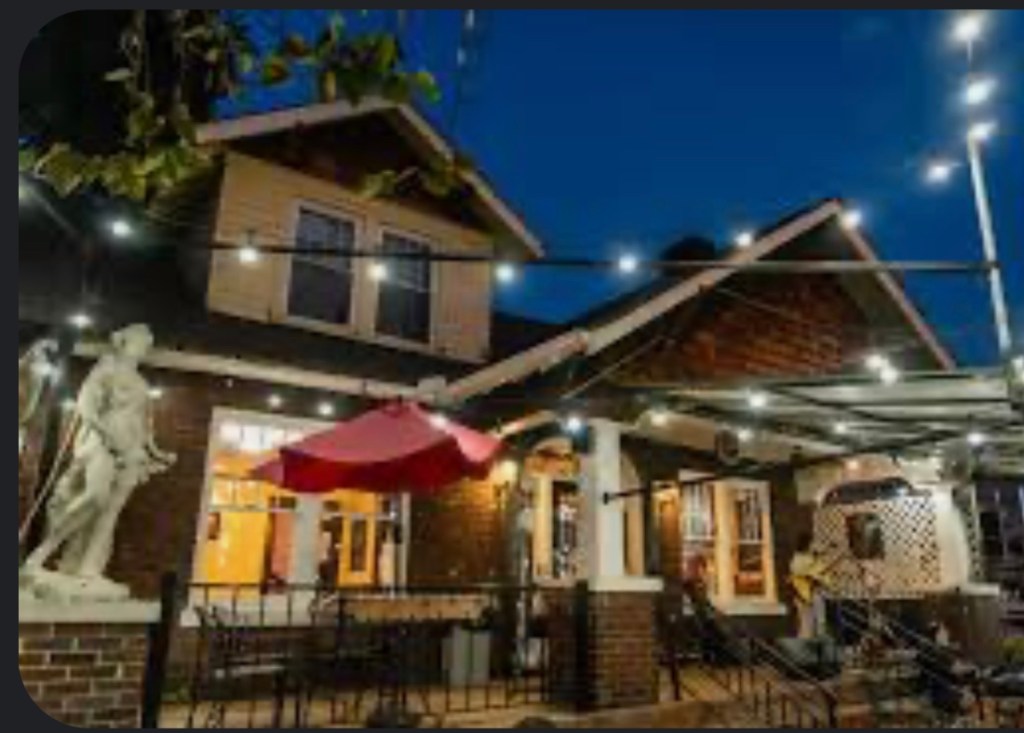
In one such re-birthed home off Elliston, a neo-beatnik coffee-beer-food joint spills red neon light into the street where dusky jazz from the “Backdeck” skitters with dead leaves down the cracked one-way blacktop— falls and rises with the daredevil sparrows that dive-bomb the al fresco eaters’ feet looking for renegade Tater Tots.
On a cloud of sweet clove cigarette smoke the hustle of something like multigenerational intellectualism floats over the noise while the silver-haired owner buses the tables himself, magnanimously, wearing jean shorts, white socks, and Jesus sandals, worn-through.







 M. N. Ashley