Learning to Be Alone (creative nonfiction)

Not the first time I was alone, but the time I learned to love being alone. Art school. Summer arts school between my junior and senior years of high school. I went for writing. I had two writer roommates. They put the writers together because they said we had a tendency to keep odd hours and they didn’t want us keeping the dancers or singers awake all night because they had to wake up early and actually work for their muse. Lazy cusses that we were, our first class wasn’t until nine and we only had two classes and one group activity a day. The rest of the time we were supposed to be typing away at our keyboards making Shakespeare or whatever. We were supposed to be getting inspired. We were supposed to be collaborating. We were supposed to be bouncing off the walls with creative energy.

Mostly I remember wandering through the halls exploring myself.

That sounds unnecessarily sexual. If I were to say exploring myself from the inside, that doesn’t make it any better. Feeling myself from the inside? No.

Understanding my own soul better. There we go. Expanding. Spreading my arms into the empty space.

The halls were white painted brick and white tile, fluorescent lights. Someone in my class, more brilliant than I in that moment, said the halls looked like Communism. I just about fell out of my tree laughing at that at the time. I’ve used that joke several times since. I’ve probably used it more than the person who cracked it in the first place. I wonder if they even remember. I wonder if their own humor followed them the way it did me.

The halls of the funky math and science building at Vanderbilt looked like Communism. The mental hospital I was in on a hold that one time—that looked like Communism too. Math and mental health and art school. There should be a connection there. Art led to math led to the nuthouse. Maybe the more talented writer who cracked the joke in the first place could do more with that than I can in this moment. Don’t expect much of me. I was great in art school, I did marginally at math, and I was not one of the popular kids at the nuthouse. It was hard to be alone there. I made myself lonely in math when I didn’t need to be and at art school I was alone, but damn I was never lonely. Damn I loved being with myself then.

There was a smell in those halls. It was the smell of freedom. I had been to summer camp before—lifetimes of summer camp—but here I had all this time to do with as I pleased, to be plying my art, and no one was up my butt to be cheery or play Red Rover. Our meal times were even flexible.

I was planning a good roam one afternoon and went to the cafeteria first to get a sandwich. I was in the middle of a bad attempt to wrap it in a yellow napkin that was too small for the job, when a handsome man who worked there, I’m sure one of the regular students, so maybe all of 20 years old, came over to me and offered to wrap it up for me. That was the kindest thing.

I thought I was being so sly. I wasn’t even sure we were allowed to take food out. I was being on the down low and he busted me—busted me, then helped me out and in such a sweet tone. I wonder if he was a writer too or if he had found his personal space there—had explored his own self from the inside wandering down those halls, so he understood the lure and understood the need to have portable sandwiches for the journey.

-M. Ashley

I Have a Book of Guy du Maupassant Stories (creative nonfiction)

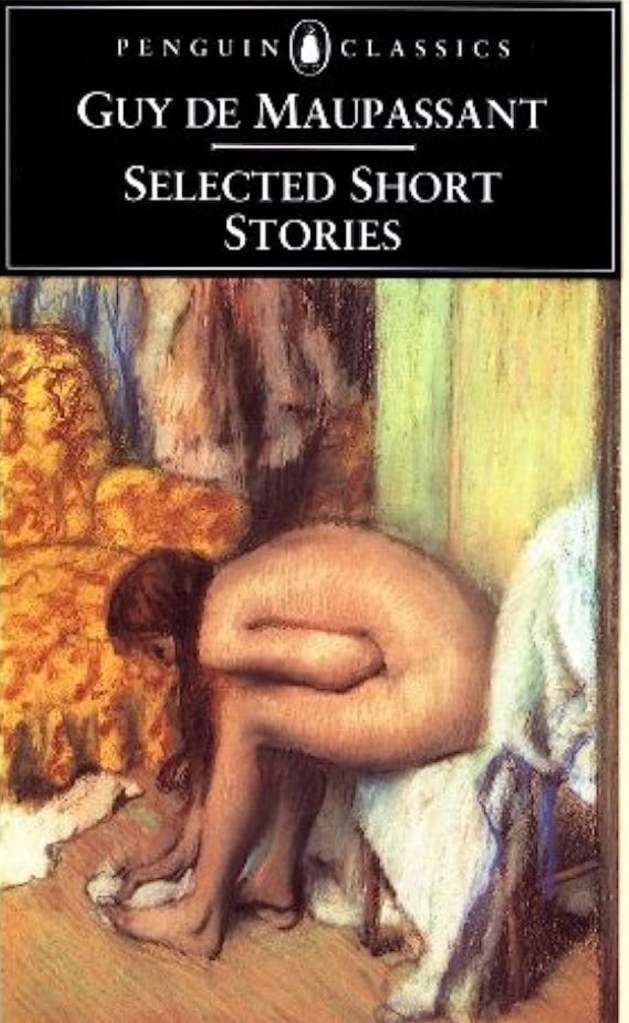
I have a book of Guy du Maupassant stories. On the cover is an impressionist painting of a woman coming out of the bath and drying her feet. I assume it’s by Degas because he’s the impressionist I did my high school French class report on and, as far as I’m concerned, all impressionist paintings that aren’t famously and obviously by some other painter, were painted by Degas.

Degas started going blind at the end of his career. Tragedy. Tragedy for him and for us. I am legally blind. The tragedy is merely personal. The world does not mourn a loss over the fact that reading, for me, is slow and difficult. I have to be choosy about what I read because it takes so much time and effort. In college, I chose to read that book of Maupassant stories. After college, I chose to read it three more times.

Those stories can be a little like Far Side cartoons. Sometimes you don’t get it on your first shot. Sometimes you need someone to explain the world and the ending to you.

My junior year of college, I had a little time between this and that, who knows—I don’t remember the obligations, I only remember the time in between. There was an in between place on the Vanderbilt campus where four paths met in a sort of pedestrian roundabout. At the center of the circle was a planter overflowing with the campus’ signature Spring yellow tulips. At the center of the planter was a blossoming dogwood, shedding its white blossoms, covering the ground in floral snow. The circle was bordered by ancient shade trees and magnolias. There were antique style street lamps dotted around. At night, they cast pale blue efficiency light. There were glossy wooden benches.

I was alone in the circle, in the in between time, in the in between place, sitting on one of the glossy benches. I was reading Guy du Maupassant. It was a bliss time. A life is only blessed with so many, and this was a precious one of mine.

I read a story about a man who observes another man’s gaudy, worldly treasures and also his beautiful daughter and wife. That’s the whole of the story—the observations of the one man and the bragging of the other on all his gaudy, worldly possessions. It’s the kind of story that, when it ends, you flip the pages expecting another ending and find only the beginning of another story. Maybe the printer made a mistake.

I stood up from my glossy bench, chewing on it. I went to my other obligation. I went back to my dorm room overstuffed with the detritus of a busy college career. I called my mom.

I told my mom about the story and asked her what she thought it meant. She said it was quite obvious, wasn’t it? The treasure was the women. In all that house full of stuff, (I looked around my own room and was embarrassed), in that house full of stuff,, (I thought about how often I had walked through that in between place circle with its gold tulips and dogwood snow and ignored it on my way from stuff-to-do to other stuff-to-do and was embarrassed), in that house full of stuff, the women were the treasure. The family bond was the most precious thing,

I thought about how often I neglected to call home in favor of some seemingly more pressing or interesting stuff. I was embarrassed. My life was stuffed with such stuff.

I told my mom I got it now. I told my mom she was an epiphany. I asked her how her day had gone.

-M. Ashley

Hairy Larry (creative nonfiction)

Hairy Larry gave me the worst haircut I have ever had. I think he was drunk at the time. It was only 6:00pm and he was in the kitchen with the rest of us, all bar friends, but also all sober. He was drunk I think, but I let him cut my hair anyway. My hair was a mess and needed some kind of attention. He was drunk, I figured, but he was always drunk, so I also figured, at least drunk, his hands wouldn’t shake.

He, himself, had ALL the hair. Pompadour and chest hair that would make a pectoral toupee jealous. He had a beard, well kept, but still mountain man worthy. His eyebrows, also well kept, but awnings enough that he never had to worry about the sun in his eyes.

He was a hairdresser by trade, or so I was told. Doing me in the kitchen was a special kindness, a special concession for bar friends. Also, doing me in the kitchen meant he didn’t have to pay a kick to his salon owner. He needed that money for booze.

He asked me what I wanted. I never know the answer to that when hairdressers ask me that question. I usually go months and months between haircuts and I never have learned to speak the language. By the time I gave myself to Hairy Larry, it had been more than a year—longer than the time I had moved into that house.

I told him I didn’t know how to describe what I wanted. It went something like medium length and, you know, not poofy. The not poofy thing is the hard part as my hair is thick and naturally curly. When I was a teenager in the nineties, I would always leave the hairdresser looking like some kind of hybrid poodle/Dolly Parton creature as my hair is as naturally platinum as it is curly and the hairdressers could never resist exercising their mad engineering skills and making it reach the rafters.

I always went home after hair appointments and washed the height out. I didn’t mind if the hair on the top of my head had no volume and the curls throughout weren’t quite as curly as they could have been. I wanted to look something like me and not something like poodle/Parton/other.

So, for Hairy Larry, the not poofy part was the challenge. I was in my late twenties by this point and although I knew very little about what I wanted for my hair, for my life, for this very moment, I knew at least one thing I didn’t want. I knew at least several things I didn’t want. At that time, I think I defined what I did want almost exclusively by what I didn’t want. I didn’t want poofy hair. Anything but poofy hair. No matter how you get there, Hairy Larry, anything but poofy hair.

Anything but the life I had been leaving before I moved into this house with three housemates, four cats, and three dogs between us. Anything but that. Kitchen haircuts and all. Anything but going back. Anything but the poodle of my teens. Anything but the you-are-not-who-you-are poof of someone else’s engineering.

-M. Ashley

The Satanic Office (creative nonfiction)

In my dream, Satan was a thin, black-haired man wearing a pinstripe suit with a white shirt and ecclesiastical purple tie. His eyes were so dark brown they were almost, but not quite, black. He sat cross-legged on the floor between his rumpled camel-colored couch and Ikea glass-topped coffee table. There were stacks of files and towering reams of paperwork everywhere.

He was insistent he was not Lucifer, nor Beelzebub, nor the Devil, nor anything like that. His singular identity as Satan, he said, was very important to him.

He was flustered in that space with the great peaks of paperwork surrounding him—all the boxes that needed to be checked, all the signatures that needed to be signed just-so by the little yellow tabs poking out diabolically here and there and everywhere.

So when I hear of someone, some ghost hunter or erstwhile exorcist, being touched by Satan and being shaken to their very core, I think of Satan this way and wonder if all he really wanted was an audit of the last twenty years which, let’s face it, would scare the hell out of anyone.

-M. Ashley

Lame Zebra (creative nonfiction)

Something as mundane as I found out he was courting other women, and yet I went on, enmeshed, with him anyway.

Courting is a nice word for manipulating. Affairs of the imagination, choosing which flesh to realize.

I sat in the car with a friend after finding out. Devastated. She told me it isn’t the lame zebra’s fault for being lame. It’s the asshole lion’s fault for going after lame zebras. I didn’t mind her calling me lame. I was lamer than that. Lame was an understatement. I was more like hobbled. The asshole lion the kind of asshole that hobbles the naive zebra then chases after her. He made her an easy catch.

I told my friend I was done. We arrived at my house and, in the dark, in my driveway, before opening the car door to let myself out, I told her I was done with him. That was it and it was over and I was done.

She patted my head and said sympathetically, “No you’re not.” A sentence of death and destruction and many, many more months of eating my heart out.

It sounds stupid, but time was the only thing that healed it. Time and he got married to one of his other lame zebras. He said she made him feel like a teenager again. That’s likely because she was the worst hobbled amongst us and, compared to her, he could run like the wind.

He wrote to me, “Since I’ve been with her, I’ve been running. Can you imagine? Me? At my age? Running?”

I wonder how long that lasted before she gave up and he, at his age, convinced her life was easier sitting, limp and licking his chops as she puts on weight and wonders what happened to her legs that used to run so swiftly, kick so high.

I took up running myself a few years later and I’m faster now than I ever was. I have no hurt for him anymore. I hurt for her. I’m sure I won’t be seeing her at any local, smalltime races anytime soon. The LA Marathon is bound to miss her as well. She might have wanted to do that before she was forty only a little less than she was terrified she wouldn’t be married by then.

Better wed and walking then a spinster fleet of foot.

I feel you sister. I do.

-M. Ashley

Unbuttoning (poetry)

He laid back into the arm of the sofa
and let me strip him to the waist.

I worked the buttons of his dress shirt
methodically, counting

(there were so many buttons)

I felt
I would never reach the shirt tail

never release him
fully,

(until I did).

His skin was cold and seemingly
lit of its own. It was

the sickly purple gray of a hot
oncoming

(interminable) night.

His chest and abdomen
all full of little scars.

He opened his languid arms, wrists
still buttoned

(and bound)

into the shirt as I bowed
to kiss

the ancient wounds.
“Like you,” he said

(graciously)

“I know something of war.”

-M. Ashley

Gods of the Inland Empire (poetry)

Of the Smoggy Valley—mountains, desert, ocean—
whichever climate you like
within an hour.

Of the sacred gray arteries—bloody asphalt—
broken glass shimmering in the shoulders—jaw-dropping
overpass knots.

Of the train that no longer whistles
the graveyard where railroad men rest—
the abandoned Catholic hospital
where railroad men were born

Of gunshots in the night—the green and
black—the godly ghetto birds—
NightSun—criminals who cannot hide.

Of skinny backyard coyotes—un-collared dogs
left to roam the neighborhood—the scarred
faces of little children mauled on their way to school
making the national news.

Of the withering Empire
of “these gangs came from LA”
of “we’re number 1 again!—
most dangerous city in the US.”

Of everybody’s got to proud of something.

Of heavy lungs
Of visible heat
Of prostitutes who stroll anyway—
immigrant tweens who twist their ankles
spiked heels stuck in the melted asphalt.

Of “this way to Vegas”
Of “this way to the baptismal sea”

Of kissing the corpse’s mouth

Of lying with it
one more night.

-M. Ashley

Nailing Down Eternity (poetry)

When nailing down eternity
two pieces of wood will do
bound together by dusty
centurions on shit duty.

Try also iron nails
in a bottle of piss with
fishhooks, sulfur,
and the dirt from a murderer’s
grief-less grave
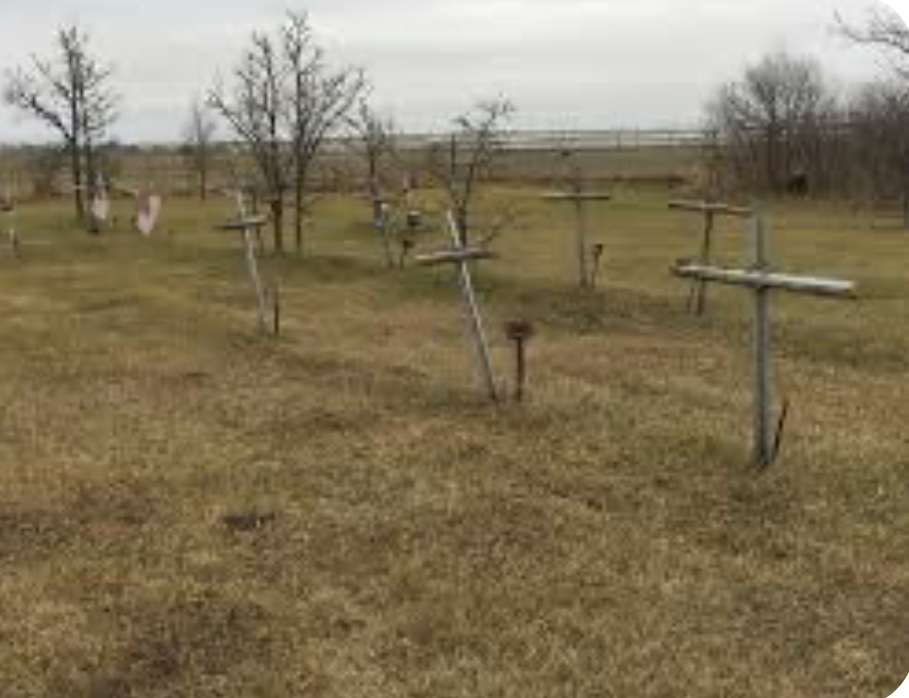
dug from the dirt patch behind
the green cemetery

not good enough
for a proper fence but bound
by torn green tarp shrouds instead
tacked haphazardly to decayed
chain link.

-M. Ashley