-loads gun-
Now, if all three of you will politely line up against that wall there and close your eyes…
-M.
Writing Life

-loads gun-
Now, if all three of you will politely line up against that wall there and close your eyes…
-M.

 I had a revelation once at writing summer camp for adults at the University of Iowa writers’ conference. I noticed when everybody read their short prose pieces that mine sounded nothing like theirs. But then I read mine and people were delightfully receptive. I wrote about my dad botching sun tea. “I’ll remember that melted orange plastic pitcher for a long, long time,” one of them said and the other two laughed and nodded while we walked away from class, across the stinking river, backs turned to the university art gallery that was featuring second-string Picassos and African furniture.
I realized in that moment and for the first time that maybe not sounding like everybody else is a good thing.
But that was all about prose. It was the opposite reaction in my advanced poetry class. I read the poem that won me the big hoop-dee-doo writing award only a few months earlier and the bald-asshole workshop leader who worked mostly in prisons and wrote about breast milk eroticism told me my poem had “a lot of work to do.”
He was mad at me anyway because when our class went out together at lunchtime and climbed up the interminable campus steps to forage for chi chi sandwiches, my retelling of going to a computer generated atonal concert that was held in the dark by a composer whose silver jacket buttons I was madly in love with got more laughs than his pretentious snarking about “language poets”.
My revelation stands.
-M.
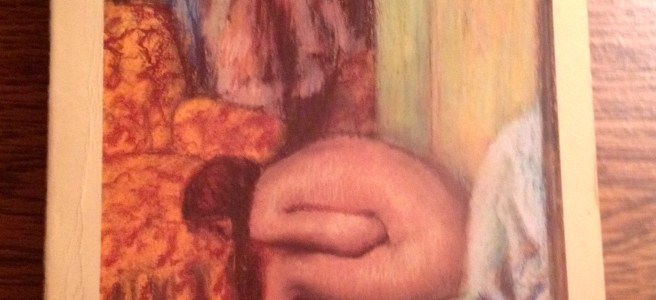
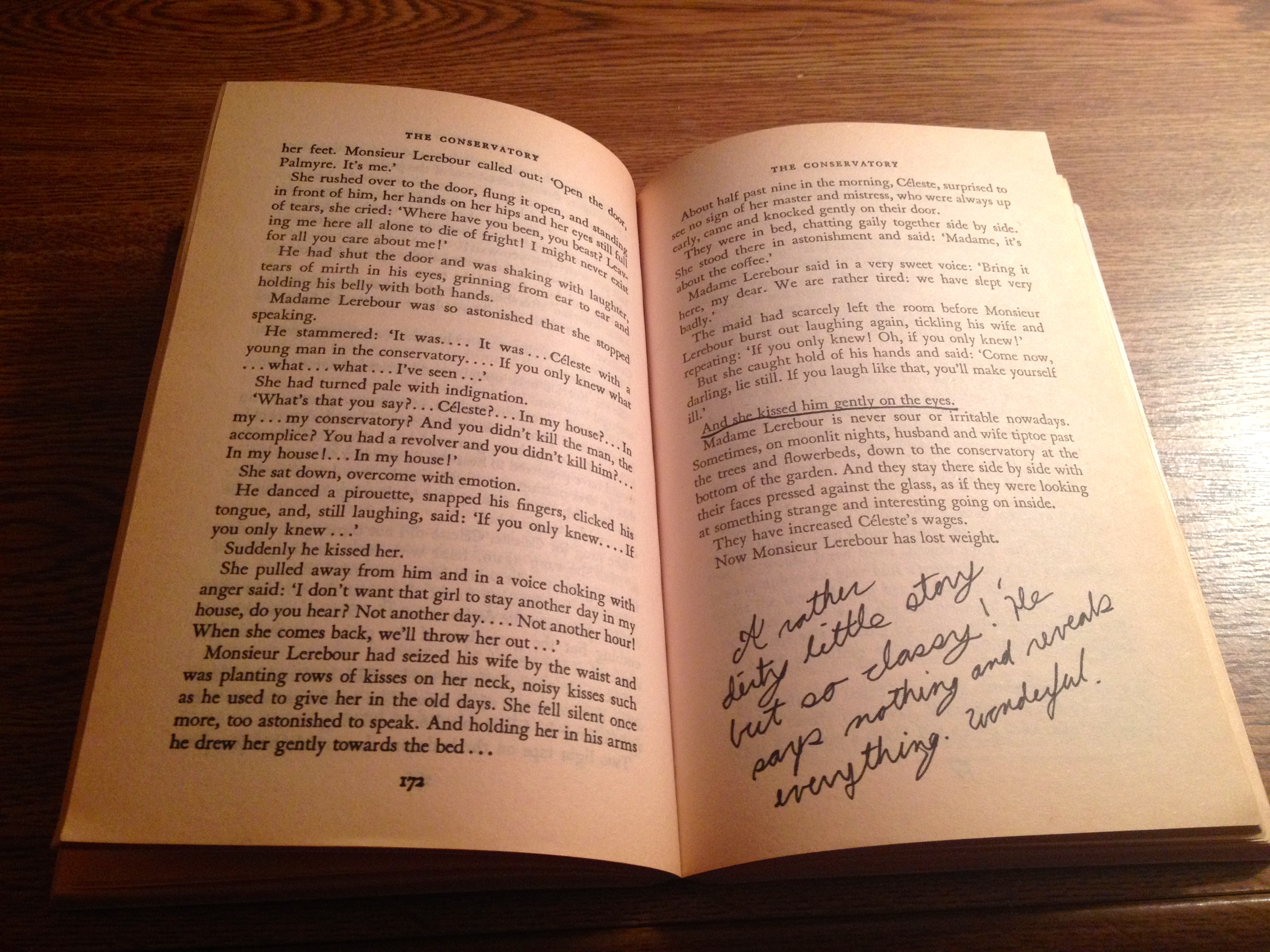 While sitting at my desk today, I glanced over at the tiny pile of books in the left corner. Among these are the only three out of my once mighty personal library that made it with me through all the hasty moving I have had to do in the last few years.
One of them, the most special, is a book of Guy de Maupassant stories. It is a holy artifact. I’ve read it two and a half times. You can see the pages are yellowed with age and use and love. The first short story to ever make me cry, (my favorite short story), is the first one in the book,”Boule de Suif”. When I was writing fiction regularly, I wrote my best stories while reading it. At Vanderbilt in springtime, I used to sit in the late afternoon on a bench in a circle of shade trees at the center of which was a blooming dogwood. The stories made me sigh and think and dream of better for my own work all while the dogwood blossoms fluttered to the ground like snowflakes.
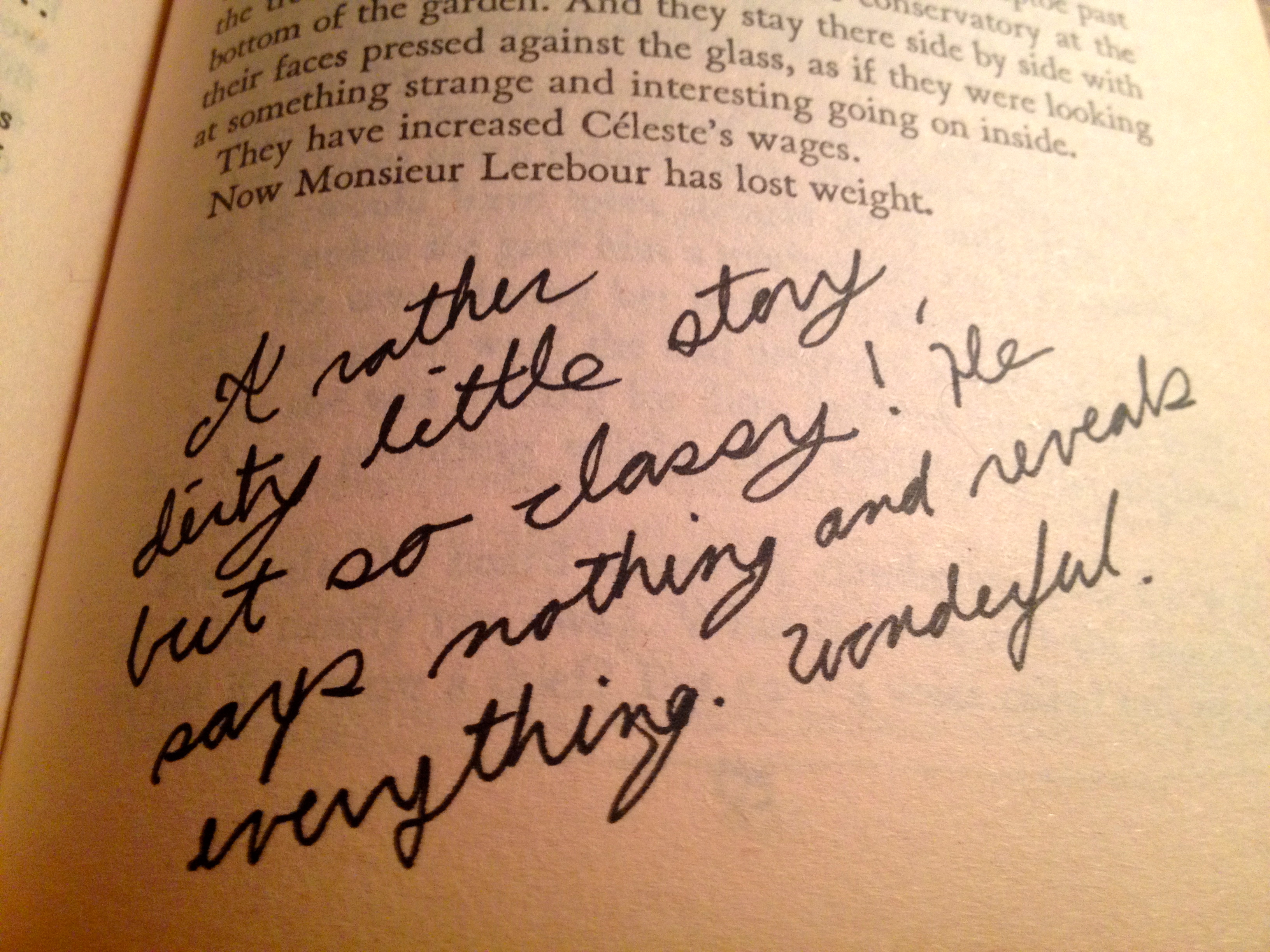 Full of both long notes and clipped marginalia, the book now reads to me something like a diary. My handwriting was better then. I am grateful for that.
Pictured here is a note on, “The Conservatory”. How amazed I was, and still am, at his gifts of humor, twist, and sly revealing.
-M.

You’ll roll from aisle to aisle
aimless and slow
eyeballing the shiniest packages first
overhead and at foot
at your groin and at your twitching nose.
You’ll make better bad choices
(still bad choices)
fill your cart with loud
brightly powdered crunchies
that exercise your jaw
but stain your hands
without so much as a goodnight kiss
or any nutritional value at all.
-M.

My ancient fiction professor at Vanderbilt creaked in his departmental chair and told us about a man he knew who drank Dr. Pepper hot. When work was over, this man would get into his after-fives and stir it in a saucepan over low heat, delicately, like he was handling milk. “Sometimes,” Professor Sullivan said, “it’s all right to let your characters take life a little too far.”
-M.

Dear Professor Weatherby,
You were one of the toughest and, by far, the most fearsome of the English department crew. Other students joked you clicked your heels when you turned corners. Professor Sullivan once said you took a swim in the Gulf and the sharks were afraid of you. You made students cry, regularly. You were outstanding.
It was such a small moment for you I’m sure, but after class one day you listened to me go on about inventing my own poetic form. You listened to me jabber on in my excitement and creative rush, (I’m sure I had turned bright red by the breathless second sentence). You listened to me, and after, you leaned in and said, “That’s what makes you a poet.”
I carry your words in my pocket to this day for when I doubt my craft. Such a small moment, but to me, it lights the way. Thank you.
-M.

 Keeping the horse before the cart, you would think, would almost happen naturally. After all, isn’t that where the horse is supposed to be? Isn’t that where her essence wills her to be?
But sometimes the natural yearning essence of the horse depends on its owner. My horse, her name is Mathilda, finds it far more natural and enjoyable to trot along behind the cart, sniffing the heather, watching the birds fly, dreaming of the far-distant future where there will be no carts at all, just a shady tree to lie under and lots and lots of lettuce to feed her and, occasionally, to roll around in in an obscene manner. The problem with Mathilda’s nature is that sooner or later the cart starts to roll downhill, and, as it is filled with countless heavy bushels full of tasks left undone, it careens faster and faster down that hill, forcing Mathilda to go from trot to canter to gallop to stumble to roll, until cart and horse and tasks and dreams end up in a crashed and broken heap.
Ah, nothing like a cheery blog to get you going in the morning!
The moral of the story is this, I have learned through hard experience and countless times digging myself out from under the rubble of crashed enterprises, to keep Mathilda up there leading the cart, all four hooves on the path, rocky though it may be sometimes. And ultimately she feels better in that spot, more purposeful and proud, and finds her time for dreaming on Sundays when the cart stops for restocking.
-M.
 M. N. Ashley